Web Development
Moonshot AI has launched Kimi K3, the largest open-source model in the world, just a step behind Claude Fable 5. What happened and what it means for your business.
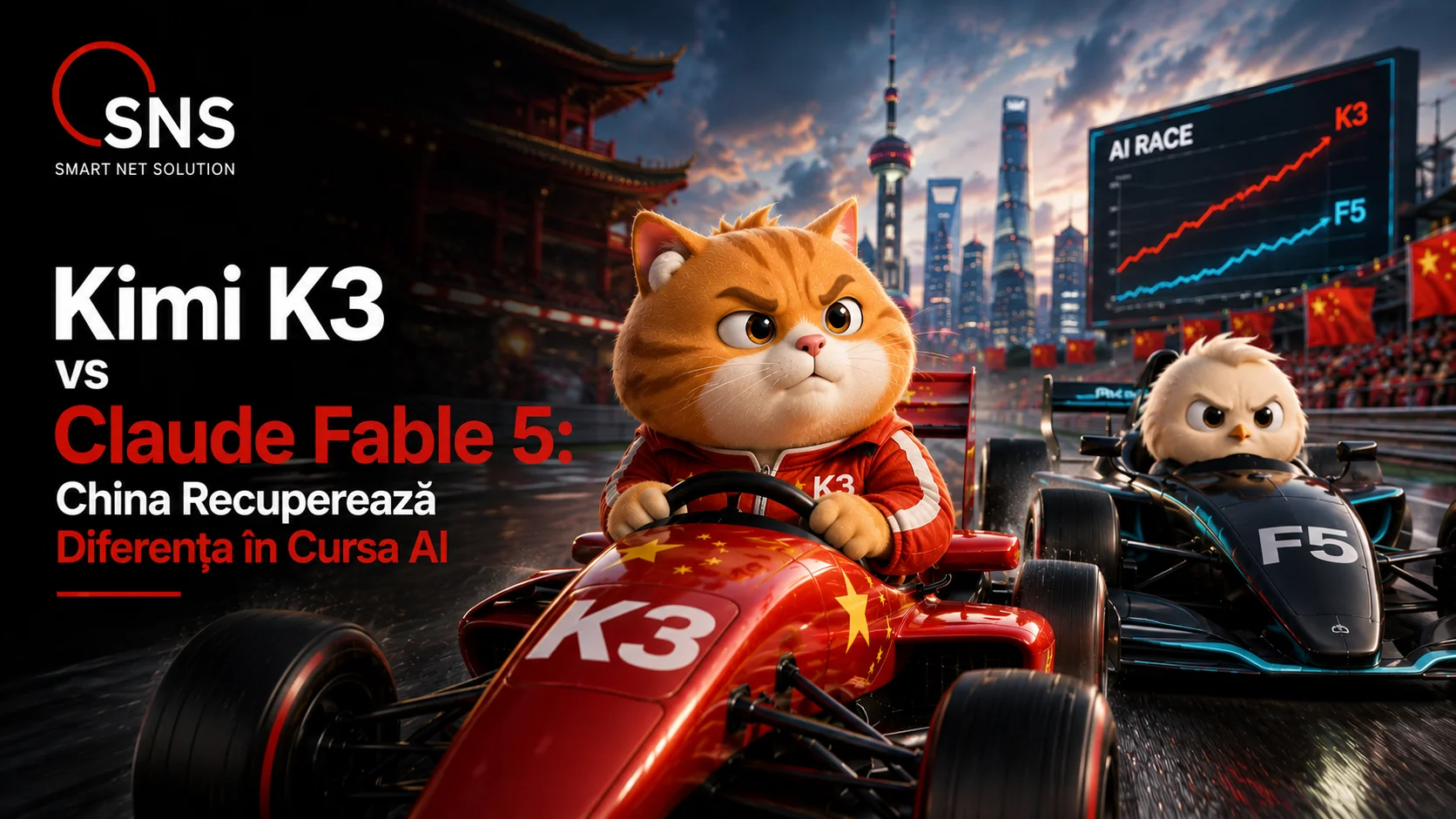
This week something happened that's worth paying attention to even if you're not a tech person: Chinese startup Moonshot AI released Kimi K3, a 2.8-trillion-parameter open-source AI model, the largest of its kind ever released publicly. Its results are just a step behind the best American models, including Anthropic's Claude Fable 5. Let's look at what actually happened and, more importantly, why you should care.
Moonshot AI, financially backed by Alibaba, released Kimi K3 on Thursday, described by the company as the largest open-source model in the world by parameter count. The model has a context window of 1 million tokens (essentially, it can "remember" enormous amounts of text within a single conversation), native visual understanding, and a permanent "thinking" mode, built specifically for long-running coding tasks and working with large volumes of code.
The company built the model on a proprietary architecture called Kimi Delta Attention, which reduces the computational costs needed for a model of this size. The practical result: although K3 still trails the most advanced American models on overall performance, it clearly surpassed Claude Opus 4.8 and older OpenAI models in coding categories and agentic tasks (where the AI executes successive steps on its own, not just answers a question).
The model's full weights are set to be published on July 27, which means anyone, in theory, will be able to download and run this model on their own servers, not just through the API.
Claude Fable 5 is Anthropic's newest flagship model, launched on June 9, 2026 alongside Claude Mythos 5, a restricted-access variant used for specialized cases (cybersecurity, biological research) where the model's full capability is needed. Fable 5 includes additional safety filters for such sensitive domains, which is why some requests are automatically redirected to an older model.
On standard coding and reasoning benchmarks (SWE-Bench, Terminal-Bench), Fable 5 clearly leads ahead of Claude Opus 4.8, GPT-5.5, and Gemini 3.1 Pro, positioning it as one of the most capable publicly available models at the moment, with Kimi K3 remaining, overall, slightly behind it.
A quick context note: Fable 5 also went through an unplanned pause. Shortly after launch, access was temporarily suspended (June 12) for compliance with U.S. export controls, then restored on July 1, after authorities lifted the restrictions.
Here's the part that, honestly, matters more to most people than a technical benchmark. Fable 5 costs roughly $50 per million tokens generated. Kimi K3 costs $15 for the same amount, expensive by Chinese standards, but three times cheaper than Fable. Other Chinese models, like GLM-5.2 or DeepSeek V4, go even lower, at $4.40 and under $1 per million tokens, respectively.
The practical takeaway: global competition in AI is pushing prices down fast, and access to powerful tools keeps getting cheaper, regardless of which company wins the headline "race."
In the same week, Microsoft CEO Satya Nadella publicly criticized the safety restrictions of Claude Fable 5, saying the model refuses too many mundane requests and that a "creation tool" shouldn't behave in such an "editorially controlled" way. The statement is all the more unusual given that Microsoft has invested $5 billion in Anthropic and offers its models through its own cloud platform.
Beyond the corporate gossip, the episode points to a real tension in the industry: some companies (Anthropic, especially) prefer a more cautious model, with strict safety filters, while others, including some Chinese open-source models, are more permissive. For you, as a business user, this simply means it's worth knowing which tool you're using for which task, since not all AI models behave the same way in the face of the same requests.
You don't need a server with 2.8 trillion parameters to benefit from this, but this competition has direct effects for a small business in Romania too:
This pace of releases isn't slowing down, and we're constantly tracking what's changing, so we can tell you clearly what's worth integrating into your business and what's just technical noise. If you want help integrating relevant AI tools into your business's workflow, without jargon and without pressure to buy something you don't need, let's talk.